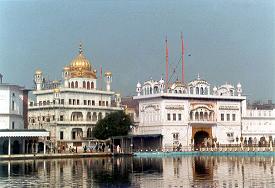
Sri Akal Takht Sahib Amritsar, 'the throne of the immortal is the supreme seat of religious and temporal authority of its kind for the Sikhs in the world. It is an institution to which every Sikh bows with honor and dignity. Since its inception, Akal Takht Sahib has been shaping the religio-socio-political destiny of the Sikhs. It has been influencing the history and life of the Sikhs. It is the most secular yet deeply religious institution of its kind in the world where spiritual and temporal power blossom together. It is a symbol of continuing faith in unifying doctrine of the Sikh religion and its non-violent politics. It is a place where divinity and dignity go together. It is a source which gives inspiration that righteousness must be defended with rosary in one hand and sword in the other. It is a supreme power to guide the future of the Sikh nation. Sri Akal Takht has played a significant role in establishing a distinctive Sikh identity of Miri and Piri.
According to H.S. Dilgeer,
“Sri Akal Takht, the Throne Of Immortal is the only institution of its kind in the world, which has been influencing the course of the history and life of a community that is essentially non-violent, yet so self respecting, most secular but deeply religious, dedicated to self-sacrifice, yet pledged to self-preservation too.
This in sense, constitutes the elan vital of the Sikh community.”
According to Bhai Kahan Singh Nabha, it is a “Raj Sanghasan” (Royal Throne) of the Sikhs.
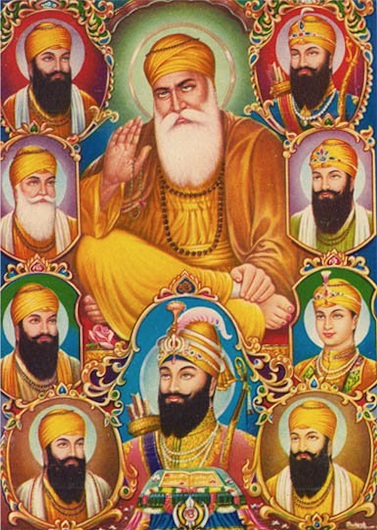
The principle place of worship in the name of Sri Harmandar Sahib was built at Amritsar (Punjab) by Guru Arjan Dev Ji (the fifth Guru of Sikhs). In close proximity of Sri Harmandar Sahib, Sri Akal Takht, the highest seat of religious and temporal authority of the Sikhs was revealed and built by Guru Hargobind Sahib which stands for protection of righteousness and human rights.
Although all the five Takhts are equal in sanctity, yet the foremost significant of the Takhts is Sri Akal Takht Sahib. This Takht is the central authority and nerve center of the Sikhs. The national and international socio-religio-political issues concerning the Sikhs are discussed and debated at the Takht. The edicts in the best interest of the Sikh nation are issued to the Sikh Sangat. The Gurmatas and Hukamnamas (Decrees) issued from Sri Akal Takht Sahib are binding on all the Sikhs, all over the world.
Background of Sri Akal Takht Sahib
Mughal Oppression
During the time when Akal Takht was built, Mughals were ruling India. Emperor Jehangir became the successor to the moderate Emperor Akbar. He asked Guru Arjan Dev to renounce Sikhism and become a Muslim. Guru Arjan Dev refused and said that nothing could get him to renounce his faith. The Emperor took it as a disgrace and ordered the Guru to be seated on red hot Iron plates. Burning sand was poured on his head. He was boiled in the hot caldrons. The Guru did not budge an inch and gave his life for righteousness on May 30, 1606. A need was felt to defend righteousness, not with rosary alone but with sword also.
According to Macauliffe, Guru Arjan Dev said in his last message to Hargobind through his followers,
“I have succeeded in effecting the object of my life. Go to my son, the holy Hargobind and give him from me ample consolation. Bid him not mourn or indulge in unmanly lamentations but sing God’s praises.
Let him also restrain from grief the other members of my family. Let him sit fully armed on his throne and maintain an army to the best of his ability.”
(p-99; Volume 111).
According to Dr. Bhagat Singh,
“this message seems to be a later concoction as it does not agree with the tenor of Guru Arjan’s life. He is known to history and tradition to be an apostle of peace and a staunch and unstinted follower of non-violence. Under no circumstances he could change his faith in the peaceful demeaner. There can be no doubt about the fact that the decision to arm the community was taken by Guru Hargobind and his followers collectively after Guru Arjan Dev had been martyred.”
(p-53; The City Of Amritsar)
Blue Star Ghallughara against the Sikhs
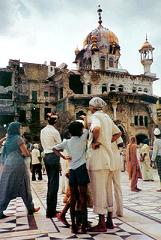
Lately, the building of Akal Takht was smashed by the Indian Army during Blue Star Operation in June 1984 when Indian Prime Minister Indra Gandhi ordered the troops to storm the holiest shrine of the Sikhs. Sri Harmandar Sahib was badly damaged. The most precious Sikh Reference Library was burnt and thousands of innocent pilgrims were killed in this operation. The Sikhs around the world were outraged. No doubt, the Government could smash the building but it could not smash the irresistible spirit of the Sikhs. This unfortunate incidence upset the Sikhs throughout the world.
Sant Jarnail Singh Bhindranwala and thousands of others who led the human rights movement of Khalistan laid down their lives during this Ghallughara.
The government says, it was Blue Star Operation but the Sikhs say, it was the third Ghallughara. Whatever it was, it bruised the Sikh psyche. The entire Sikh community felt shaken, humiliated and grievously hurt as a result of this sacrilege.
Wounds can heal but the damage done to the nerve centre of the Sikhs would continue to agonize the bleeding history of the Sikhs. This operation added one more fissure into the Sikh minds which could have been avoided prudently.