Guru Gobind Singh Ji
Liberty, Equality, Fraternity, Self Defence and Self-Sacrifice.
Guru Gobind Singh is the tenth Guru of the Sikhs. He was the only son of Guru Tegh Bahadur Ji. He was born to Mata Gujri on December 22, 1666 at Sri Patna Sahib in Bihar when his father was on a preaching mission to holy places in Assam.
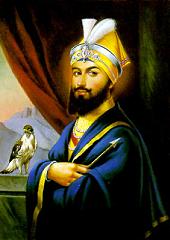
Birth name of the Guru was Gobind Rai. He was anointed Guru at the age of nine after the martyrdom of his father, Guru Tegh Bahadur Ji at Delhi.
Guru Gobind Singh had four sons namely;
- Baba Ajit Singh,
- Baba Jujhar Singh,
- Baba Zorawar Singh,
- Baba Fateh Singh.
Guru Gobind Singh revealed the order of Khalsa Brotherhood at Sri Anandpur Sahib.
On the day of Baisakhi in 1699 at Anandpur Sahib, Guru Gobind Singh urged the Sikhs to take a pledge to lead a pure life as taught by the other nine Gurus.
Amrit was prepared and first five Sikhs were initiated into the order of Khalsa Panth. Thereafter, the Guru took initiation from the Panj Pyaras and merged entity of Guru into Panth and entity of Panth into Guru. Guru Gobind Singh gave the name of 'Singh' and 'Kaur' to males and females respectively to be used after their first name.
The Sikhs were ordained to wear five Kakars and also to lead an exemplary life of Sikh Reht. They were required to stay away from committing Kurehts, that is, they were ordained not to trim hair, not to use intoxicants, not to eat Kutha meat and never to commit adultery.
All this happened at a place now called Takht Sri Kesgarh at Anandpur Sahib. Hola Mohalla and Baisakhi is celebrated every year at Sri Anandpur Sahib.
Guru Gobind Singh gave enormous importance to the Khalsa Reht and wearing of five articles of Sikh faith. He specifically stated that so long as Khalsa lives under Reht and discipline, I am delighted for him.
"Rehani rahe soi Sikh mera, oh Sahib mein uss ka chera."
Panj Pyaras (Chosen Ones)
-
Bhai Daya Ram, thirty years old, a Khatri from Lahore, now in Pakistan; He was named as Bhai Daya Singh after being baptised.
-
Bhai Dharm Das, thirty years plus old, Jat-Agriculturist from Rohtak / Hastna Pur; He was named as Bhai Dharm Singh after being initiated.
-
Bhai Himmat Rai, thirty eight years old cook from Jhiwar (Water carrier) caste, Jagan Nath Puri in Orissa; He was named as Bhai Himmat Singh after being baptised.
-
Bhai Sahib Chand, thirty seven years old Sudra and barber by caste from Bidar in Karnataka. He was named as Bhai Sahib Singh after being baptised.
-
Bhai Mohkam Chand thirty six years old Washerman from Dwarka in Gujrat. He was named as Bhai Mohkam Singh after being initiated.
The Panj Pyaras were ordained to wear Five Kakars viz.
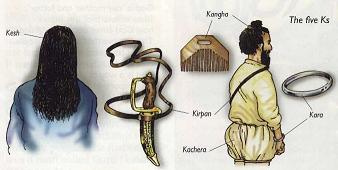
- Kes (uncut hair)
- Kangha (Comb)
- Kara (Steel wristband)
- Kachhehra (Shorts)
- Kirpan (Sword)
Guru Gobind Singh conferred the appellation of "Singh" to men and "Kaur" to women. They were required to stay away from four Kurehts and live a pure and pious life to attain God.
Four Kurehts are:
- Removing hair
- Eating Kutha meat
- Using of Tobacco and intoxicants
- Adultery
Guru Gobind Singh fought many battles for liberty, equality and fraternity. Pir Budhu Shah fought for Guru Gobind Singh in the battle of Bhangani.
Guru Gobind Singh had to vacate Anandpur Sahib in good faith during 1704. Army of the enemy attacked him at night when the Guru was crossing rivulet Sirsa. Last battle was fought against tyrant Mughals at Khidrana, Muktsar (Punjab, India).
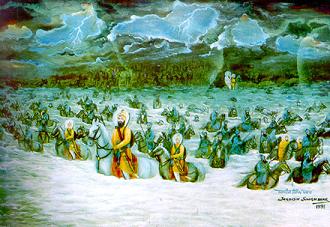
The Guru sacrificed his great grand father, father, four sons and mother for the Khalsa Panth.
Guru Gobind Singh advocated,
"when all other means fail to uphold righteousness, it is morally right to take up arms."
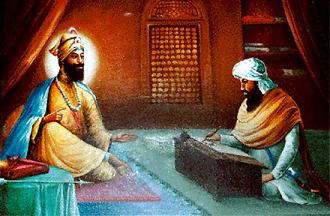
He added Bani of Guru Tegh Bahadur into Adi Granth at Damdama Sahib and conferred Guruship upon Granth Sahib on October 6, 1708 at Nanded before he died on October 7, 1708. Thereafter, the Adi Granth came to be known as Sri Guru Granth Sahib.
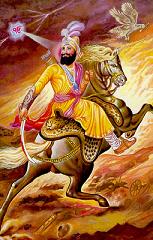
Guru Gobind Singh was a great warrior and a spiritual leader. He had to spend most of his time fighting against the oppression and suppression committed by the unjust forces. He was a unique nation builder who fought for righteousness. He sacrificed his all for human liberty, equality and fraternity.
He added Bani of Guru Tegh Bahadur into Adi Granth at Damdama Sahib and conferred Guruship upon Granth Sahib on October 6, 1708 at Nanded before he died on October 7, 1708. Thereafter, the Adi Granth came to be known as Sri Guru Granth Sahib.
Two of his youngest sons were bricked alive. Sahibzada Ajit Singh and Jujhar Singh were martyred in the battle of Chamkaur Sahib.
Guru Gobind Singh composed several works which later were compiled into Dasam Granth by Bhai Mani Singh.
Before his departure from this world, Guru Gobind Singh detailed Banda Singh Bahadur to fight against oppression and suppression.
Successor to Gurgaddi
Guru Gobind Singh conferred Guruship on Granth Sahib on October 6, 1708. Thus Granth Sahib became Sri Guiru Granth Sahib.
Contemporary Ruler of India
Aurangzeb from 1658 to 1707 A.D.
Bahadur Shah from 1707 to 1708 A.D.
Special Contribution
- Inaugurated Khalsa on March 29, 1699 by initiating Amrit to Panj Pyaras.
- Gave gift of Five Kakars and Sikh Code of Conduct.
- Author of Dasam Granth.
- Conferred Guruship upon Granth Sahib in 1708.
City Founded
Paonta Sahib.
For more reading,
- see The Saint Soldier under Publications.