Education and Sikhs
Education in Sikhism means, continuous development and integration of human personality. The education or knowledge is treated as the third eye through which an individual can see in and outside. Education aims at widening the wisdom horizon of a person for development of spiritual tendencies. It aims at making a person wise, academically and spiritually. Next to worship of God, Guru Nanak Dev loved the acquiring of knowledge.
Guru Nanak Dev says,
“By the Guru’s grace, man dwells on the Lord’s knowledge and, reading and studying it, gathers glory.”
ਗੁਰ ਪਰਸਾਦੀ ਵਿਦਿਆ ਵੀਚਾਰੈ ਪੜਿ ਪੜਿ ਪਾਵੈ ਮਾਨੁ ॥
(1329)
The concept of education in Sikhism is summarized as
“He is learned indeed who is benefactor of others.”
ਵਿਦਿਆ ਵੀਚਾਰੀ ਤਾਂ ਪਰਉਪਕਾਰੀ ॥
(356)
Bhagat Kabir says,
“To instruct his mind, man ought to study Divine knowledge to some extent.”
ਮਨ ਸਮਝਾਵਨ ਕਾਰਨੇ ਕਛੂਅਕ ਪੜੀਐ ਗਿਆਨ ॥
(340)
But the education and knowledge comes to a person with the mercy of the Lord.
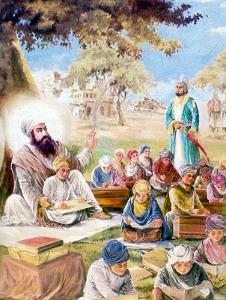
Guru Nanak Dev remained busy in gifting the concepts of life and spreading his mission. Guru Angad Dev took keen interest in imparting education to the Sikhs and gave them a systematized Gurmukhi primer.
In the times of the Gurus, Gurdwaras were used as Pathshalas to teach Gurmukhi to the Sikh youths. All the Sikh Gurus tried to teach Gurmukhi to their followers so that they could read and understand Gurbani enshrined in holy Granth Sahib.
Education in Eighteenth Century
Eighteenth century was a test period for the Sikhs when more than two hundred thousand Sikhs were killed in less than fifty years on the altar of religious bigotry. Many a times, the Sikhs had to flee to Jungles where education facility was not available. They could not find time to give attention towards education of their new generation. The period from cross to crown of Maharaja Ranjit Singh was thus not favorable to the Sikhs education wise. After consolidation of his empire, the Maharaja started few of the schools. Soon after his death, the times were again not favorable. The British rulers tried to impose the system of education as suited to them.
Education in Nineteenth Century
Many evils interrupted into the society due to which the Sikh faith also faced a little jolt.
By the end of the 19th century, the Sikhs had realized that all their efforts to bring reforms would be fruitless unless they educate the community. The Sikh youth were vulnerable to the onslaught of spurious values and harmful practices. The best time for the Sikhs to fight against the vices was to “catch them young”.
Opening of Khalsa Schools and Colleges
The Sikh Educational institutions were founded with a mission in mind.
One Daud Singh, was the first Sikh to embrace Christianity in 1852. He was baptised in Kanpur. Maharaja Duleep Singh accepted Christianity in 1853.
Four Sikh pupils Aya Singh, Attar Singh, Sadhu Singh and Santokh Singh of the Amritsar Mission School proclaimed their intention to join Christianity in 1873. Sikh literature was garbled at behest of the British. This shocked the Sikh nation.

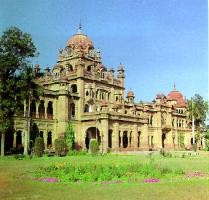
The Singh Sabha movement took its birth to provide an answer to the educational problems of the Sikhs. The Sikh organizations started taking keen interest in promoting education among the Sikhs. The first idea was to open Khalsa College at Lahore to give education to the Sikh youth according to Sikh philosophy. On insistence of some Sikhs, it was agreed to by the government to open the Khalsa College at Amritsar. Thereafter many Khalsa schools were opened in Punjab.
Education in Twentieth century
Twentieth century played a significant role in the Sikh learning. There are few of the missionary institutions to teach Sikhism in and outside India. There was a flux of Khalsa Schools and Colleges in Punjab. Guru Nanak Dev University and Punjabi University were opened at Amritsar and Patiala respectively. Punjabi language and Sikh literature was given opportunity to flourish.
There seems to be a proposal by the Shiromani Gurdwara Parbandhak Committee Amritsar to open a new University to promote Sikh literature and the Sikh way of life. Sikhs in foreign countries have opened many Khalsa institutions to impart academic education along with education about the “Sikh Code Of Conduct”.
Majority of the Gurdwaras are running Punjabi schools throughout the world. Similarly, there is chain of educational institutions started in England, Canada, America, Malaysia, Singapur, Africa, Australia, Norway and other countries of the world which promote Punjabi language and Sikh philosophy.
The Sikh institutions throughout the world have created great Sikh scholars, educationists, writers, scientists, mathematicians and doctors.
It was encouraging that many Khalsa Institutions were opened in Post independence era in Punjab. Many Public schools started giving good education to the students. Bad luck played its part. Most of the Khalsa Schools which were established to spread Sikh way of life, were handed over to the government by the governing committees alongwith mega buildings and rich resources. This imprudent act resulted in estranging the Sikh youth from the Sikh way of life.
Purpose of Sikh Educational Institutions
After the fall of the Sikh Empire and with the advent of Macaulay’s English Education, the Sikhs felt real threat to their religion and identity. Sikh boys and girls were weaned away from the Sikh way of life and were being attracted towards the glamorous cultures of foreign countries. They were drifting away from their roots. There arose a feeling of renaissance in the Sikh thought during the nineteenth century to save its youth from the invading cultures. The Sikh youth needed to be provided with education in such a way that they develop the feeling of pride in being a Sikh with identity as given by Guru Gobind Singh Ji on the day of Baisakhi in 1699 at Sri Anandpur Sahib.
Great need was felt to make reforms in the education system. Singh Sabha movement was spurred to spread the Sikh philosophy and Sikh way of life. The intention was to insulate the Sikh youth from the undesirable and unsavory onslaught of the western culture.
Various schools and colleges were opened to preserve the culture and Sikh heritage. These institutions made all possible efforts to create awareness among the Sikh youth through the Sikh values and cultural parameters. In fact, the real objective of establishing the educational institutions was not merely teaching the prescribed curriculum but to develop the personality of the Sikh youth as a whole so that the youth might become proud of their culture and live the honorable Sikh way of life. The ultimate objective was search of the truth. It was to inculcate the sense of knowing the cardinal principles of Sikhism so that the youth could contribute meaningfully to the growth of Sikh society.