
“The poor and the rich are both “brothers” (i.e. neighbours). This is Lord’s immutable design.”
(Note: Men and women are equal in Sikhism. Therefore, “he” should be read as “he or she” and “brothers” as “brothers and sisters”, and so on.)
Nir-dhan sar-dhan dono bhaaee.
Prabh ki kalla na meti jaaee.
(Guru Granth Sahib, the Sikh Holy Scriptures, p.1159 )
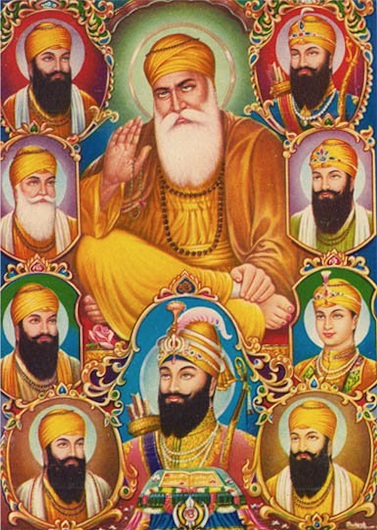
Sikhi is the Sikh way of life. This word-concept is preferred to “Sikhism” to describe the Sikh faith or religion. Guru Granth Sahib (GGS) is the Sikh holy Scripture. There were ten Sikh Gurus or Teachers. It is the Sikh belief that all “Guru personalities” carried the same spiritual Light (Jyote) of Guru Nanak, the founder of the Sikh religion (1469 – 1539). Ultimately the Guru is the Guru’s teaching (Gurbani) embodied in Guru Granth Sahib, revered as the Living Guru of the Sikhs. Due to the Sikh belief in One Guiding Light only, the Guru is a singular concept in Sikhi. The Guru shows the path of truthful living in the Lord’s Will (Hukam). It is the path of a working householder, who shares his earnings with those who are less well off.
Sikhi addresses the question of poverty at religious, social, economic and political levels.
Poverty and plenty are realities of life. The above quotation is from a Shabad (hymn) in Guru Garnth Sahib (GGS), the Sikh holy Scripture. Says the Guru in this Shabad,
“No one respects the poor. No matter how hard the poor man tries, the rich ignore him. When the poor man goes to the rich man, the latter turns his back on him. When the rich man goes to the poor man, the latter welcomes him warmly and offers him a seat with respect.”
(GGS p. 1159)
Yet, the Guru continually associates Himself with the poor (the gareeb), for it is amongst the poverty stricken, the gareeb, that humility and respect for life is found. It is through the “experience” of poverty that one learns humility. That “experience” may be real experience in life; or, as in the case of Guru Nanak, in may be “felt” as a reality of human existence.
Guru Nanak was born in a high caste and well-to-do business family. He discarded the Hindu sacred thread (jeneiu) symbolising high caste and associated himself with the poor, the gareeb. Therefore, in His Shabads, Nanak refers to Himself as gareeb. In fact he wanted to be called “Nanak, the gareeb”. He empathised with the condition of the poor. Gareeb also means “humble” and the Guru used the word in both senses.
So much is the Guru’s feeling for the poor that in His tenth human form (Guru personality), as Guru Gobind Singh, He persuades the rich and the powerful to accept the underprivileged (due to low caste and poverty) as their equals and as own brothers and sisters. At one time, sensing that His message for the creation of a just order in which all shared alike was falling on deaf ears, He went so far as to warn, that the poor shall take over as the rulers of the land (In gareeb sikhan ko deun paatshahi – Guru Gobind Singh addressing the hill rajas at Ravalsar in Himachal Pardesh in Northern India.) This was also the Guru’s indirect prediction of the socio-political disorder which would result from socio-economic inequalities.
Guru Nanak refused to sit and eat with the rich who did not earn their living by honest means and who did not share with the less well off. He refused the invitation of such a rich man called Malak Bhago to a lavish banquet. Rather, he preferred to sit and eat with a poor carpenter called Bhai Lalo, who had received Him at his house with respect and humility.
Guru Nanak was born in a high caste family but he condemned the divisive and humiliating Brahmanic caste system, which created inequalities in human society. This system condemned the low caste to a life of servitude which depended on charity and led on to poverty. Therefore, Guru Nanak, was the gareeb, the low caste.
“Nanak seeks the company of those who are lowest of the low caste. He has no desire to compete with the rich and the powerful.”
“Neechan andar neech jaat, neechee hoo att neech. Nanak tin ke sang saath wadhian seo kia rees”
(GGS p.15)
Thus, poverty and how to deal with it through sharing (wand shakna) becomes one of the main themes of Sikhi (the Sikh way of life). Yet, whilst poverty is accepted as a human condition with which human beings may be afflicted through no fault of their own, Sikhi teaches constant effort to earn own living and to share with those who are not doing well. There is recognition in Sikh that poverty has many causes, some within and some without human control, but all in God’s design (kalla).
The Sikh Institution of Langar, the Community Kitchen.
The Guru’s life formula is:
“He who eats what he earns through honest work and shares with others, he alone O Nanak recognises (follows) the true path in life.”
“Ghaal khai kish hathon day. Nanak rah pehchaanay say”
(GGS p. 1245)
That means, one who earns own livelihood and gives something to the needy, follows the true path. Living on charity is not the Sikh way. Sharing is through the social system symbolised (and practiced) in the Sikh Community Kitchen (Langar) at Gurdwaras. It is a pointer to the establishment of a community-wide system for sharing with, and giving shelter to, those in need. The idea is not to make others dependent on charity but to enable them to receive help from a social system set up for the purpose, with dignity. Therefore, all, the rich and the poor (Sikh and non-Sikh), without distinction, are required to sit side by side in the Langar at a Gurdwara and partake food. Langar is the Guru’s educational institution giving first lessons in sharing, service, humility and equality. Even giving and receiving of so called “charity” must not detract from human dignity. It must be given and accepted in humility, without any sense of pride (haomai) in the giver, or loss of personal dignity in the receiver. In this sense the Sikhi concept of “charity” may be unique amongst world religions.
In Sikhi, experience of poverty, real or felt, teaches us humility. However, poverty is not a virtue in itself. A Sikh lives within the system based on the “community kitchen”, the Sikh institution of Langar to which he should contribute (pay daswandh i.e. one tenth of earning regularly); and from which he may feed himself. Langar is also symbolic of the Sikh welfare system. That welfare system is a model for the human society. Otherwise, Sikhi is based on continuous effort to earn own livelihood; begging and dependence on charity are forbidden.
Sacha Sauda: True business
One of the oft quoted teaching episodes in Guru Nanak’s life relates to feeding the poor and the hungry. He had been given some money by his father to do business. Instead he spent this money to feed the hungry and regarded that as a “true bargain” (sacha sauda). It is true that a business cannot remain viable without making profit. However, in Sikhi, short term gains should not be at the expense of creating long term inequalities in the human society. Therefore, social systems, state policies and longer term business aims need to complement each other to ensure that the underprivileged are not forgotten. That is true business (sacha sauda), a concept accepted by many modern large businesses. Today’s businesses need prosperous and stable societies based on equality principles in future to thrive.
God’s kalla (system or design) of the brotherhood of the poor and the rich is the reality of life. The rich and the poor are both brothers (Nirdhan sardhan dono bhaaee – GGS p.1159). The brother who is better off cannot afford to ignore his poor sibling. This leads on to the global socio-political goals of Sikhi.
Socio-political Goals of Sikhi
World peace and survival of humankind in the long run depend on the egalitarian principles of equality and sharing on this earth, also referred to as the “Great Mother” in Guru Granth Sahib (Mata dharat mahat), who feeds her children. All human being are brothers and sisters and must learn to share, and live in peace and with dignity.
For this reason, the Sikh socio-political objectives are described in three words in the Sikh slogan, “Degh, Tegh, Fateh !”
Degh is the cauldron symbolising community kitchen and the principle of sharing with dignity. This leads on to welfare, social and economic objectives.
Tegh is the sword of justice and equality which protects the week and creates an egalitarian order so that “No one inflicts pain on another in a Halemi raj, or global benign regime.” (GGS p.74).
And so the socio-political objective of the Khalsa Panth, the Order of the Khalsa (those directly linked with the Guru), laid down by the Tenth Guru, Gobind Singh, is that Degh and Tegh shall ultimately prevail on this earth, this “Temple of God”. (Degh Tegh jaag meh doun chaalay)
© Copyright Gurmukh Singh (U.K.)
E-mail: sewauk2005@yahoo.co.uk
Please acknowledge quotations from this article
Articles may be published subject to prior approval by the author