
Quadricentennial Celebrations of the First Installation of Aad Granth Sahib at Darbar Sahib, (Golden Temple) Amritsar.
"By the Command of the Timeless Being the Order of the Khalsa was ordained. All Sikhs are enjoined (final injunction of the Tenth Master, Guru Gobind Singh), to accept the Granth as the Guru."
Couplet sung at the end of Sikh supplication, "Ardaas".
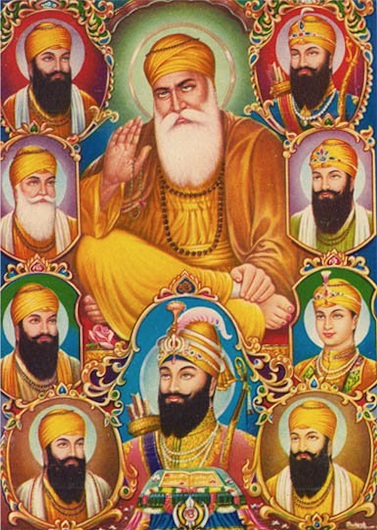
The Sikh scriptures were collated as Aad Granth in 1604 by the Fifth Guru, Guru Arjan Dev. The final version of the Granth was completed by the Tenth Guru, Guru Gobind Singh, at Damdama Sahib in the year 1705. He added the hymns of his father, Guru Tegh Bahadur, the Ninth Guru, to the volume collated a century earlier. Later, in 1708, the sacred volume was proclaimed as Guru Granth Sahib, the Word-Guru.
Therefore, Guru Granth Sahib was collated by the founder-Gurus of Sikhism themselves during the person-Guru period (1469 - 1708), and the authenticity of the Holy Scripture has never been in any doubt. This distinguishes this sacred Volume from the holy scriptures of all other main religions of the world. The holy texts of all other major world religions were transmitted through an oral tradition and were collated and scribed long after the demise of their founders. However, in the case of the Aad Granth (later instituted as the Guru), the fifth Guru, Guru Arjan Dev himself selected and dictated the text to Bhai Gurdas who wrote it down.
The Sikhs believe in their holy Book, Guru Granth Sahib, the Word-Guru, as the eternal Living Guru. They do not believe in any person-Guru, other than the Ten Guru personalities before the Granth was ordained as Guru (1708). For this reason, the Sikhs are called the people of Ahl-e-Kitab or "people of the sacred Book".
The Sikh holy Scripture, Guru Granth Sahib contains hymns of the Sikh Gurus and, quite uniquely in the world religions, the hymns of God-devotees of other religions: Hindu and Muslim saints (Bhagats) from very diverse religio-geographical backgrounds. The hymns of Kabir and Ravidas from Benaras, Jaidev from Bengal, Ramanand from UP, Sheikh Farid from Punjab, Namdev, Tarlochan and Parmanand from Maharasthra, and Dhanna from Rajasthan are included. These sacred hymns are called Shabad or Gurbani (the Guru's Word); also, all the hymns in Guru Granth Sahib are referred to as Bani or Gurbani - the Word revealed to the Guru, or to those Bhagats, whose hymns have been selected for inclusion in Guru Granth sahib. Guru Granth Sahib is the embodiment of the revealed Word over a period of about five centuries to 1708. Hymns by Bhagat Sheikh Farid are from 12th and 13th century, and the latest hymns are of the Ninth Sikh Guru, Guru Tegh Bahadhur (1621 - 1675). Truly, Guru Granth Sahib is a treasure house of the spiritual experience and holy wisdom for the guidance of humankind over five centuries, and transcends all type of human divisions and barriers. This medieval period was the period of "new awakening in the cultural history of Punjab".
The Word from Waheguru (the Wondrous Dispeller of Darkness) was revealed through the Sikh Gurus (1469 - 1708), and many poet devotees of God, the Bhagats. It is a compilation of spiritual hymns with a shared theme based on the Mool Mantar, the Primary Mystical Formula, revealed to Guru Nanak Sahib. The Bhagats came from diverse religious and social backgrounds.
"It was, so to speak, an integral congress of minds and spirits operating on the same spiritual beam. To have thus elevated the songs of the bhaktas and the bhats to the condition of the logos was to salute the power of the word whatever form it might take to reveal the glory of God. For, it may be observed that Guru Granth Sahib comprehends the compositions and utterances of the high-born Brahmins and the proud Kashatriyas as also of the so called lowly Shudras and the unlettered Jats. This was done at a time when the caste system in India had paralysed the conscience of man. The revolutionary egalitarianism which such a step symbolized was, therefore, to become the creed of the Sikhs."
(Dr. D.S.Maini's article in Studies in Sikhism and Comparative Religion, Oct, 1987)
Therefore, in Guru Granth Sahib, due to its authorship by a "parliament of religions" the Word-Guru brings a universal message for the benefit of all humankind without any distinction. Yet, undoubtedly, the theme of the message is uniquely Sikh; for the philosophy elaborated upon is that of the Mool Mantar, revealed to Guru Nanak Sahib. The Gurbani in Guru Granth Sahib, bases inter-human and God-human relationships on this Primary Mystical Formula:
There is One Creator of all i.e. One in all and all in The One.
Truth is the Name (of this One Creator, otherwise called by many names)
There is no fear or hatred (because all is within this Source of all creation)
Outside Time
Not born, Self existent
May be known through the Guru (the Dispeller of Darkness, Who, through the revealed Word (the Word-Guru), ultimately, is the One Creator Being).
This unique description of the One Source of all creation is also the source of all Sikh institutions. In fact, all the hymns of Guru Granth Sahib relate back to this Mool Mantar, the Primary Founding Formula, by constantly referring to it in full or as an abbreviation. The Mool Mantar gives the prescription for God-nearness through certain freedoms and detachments e.g. freedom from fear and hatred, freedom from fear of time (birth/death cycles) by being close to the Timeless Source of all creation. The equality principle relating to humanity and creation, inherent in Sikh thought and institutions has been derived from an interpretation of the Mool Mantar, e.g. non-discrimination in the Gurdwara (all have the right to worship in sangat - the holy congregation in the presence of Guru Granth Sahib.) and langar (sharing of food and symbolic of community service and sharing with the needy). God is universal, One and outside gender classification. Men and women are equal before God and no one religion can have any proprietary claim over the One Source of All creation..
By stressing the direct Word-Guru and Sikh relationship (Khalsa relationship), without the need for an intermediary, Sikhism "becomes timeless and universal". This direct (Khalsa) relationship is another way of stressing the personal responsibility and need to seek the One Universal Truth within oneself, and not through some prophet, human guru or priest.
A Sikh's relationship with the One Creator is based on love, and not on fear due to the total faith in God's Will and Command (Hukam). That all is in Hukam and nothing outside. Acceptance of "bhana" (the operation of God's Will) is an essential part of the Sikh way of thinking and living. The "awe" of Waheguru, the Wondrous Dispeller of Darkness, is in the form of an overwhelming admiration and experience of His creation.
The relationship between Guru Granth Sahib, the Word-Guru, and a Sikh is a daily living experience. With humility, supplication, constant remembrance of the "Name" (Naam), and daily singing of the hymns (Shabads), a Sikh seeks guidance from the Living Word or Shabad Guru.
The concept of "Word" (Bani or Shabad) may not be readily understood by students of Sikhism. That understanding comes from experience of reciting or singing Gurbani. To quote Dr. I J Singh,
"Sikhism presents a unique and heightened concept of the "Word" and from this concept has developed a unique tradition and a new worldview. Guru Granth speaks not only of the written and spoken word but also of the unspoken word - anhad - in Sikh parlance, inadequately translated as the sound current, to which only the inner self resonates in a condition in which the human mind becomes a part of divine connectivity."
The Word is the Teacher, the Guru:
"The Word is the manifest spirit of the Guru; The Guru is immanent in the Word."
(GGS p. )
The Gurbani, in Guru Granth Sahib is in verse.
"As I receive the Word of the Lord
So I express it, O Lalo"
(Guru Nanak)
The Word received was in meditative musical verse. Gurbani kirtan (singing of the hymns in Guru Granth Sahib) is an "experience" of the Word. The understanding comes with repeated experience through Gurbani kirtan. Therefore, the musical aspect is stressed in Guru Granth Sahib. With few exceptions (e.g. the first liturgical part), the name of the raag (mood-inducing melody) is always mentioned before the author. The musical sound creates the environment and mental state for focussed reception of the Word. Singing the praises of the lord in sangat (holy congregation) takes precedence above all else, to be able to sing with and listen to others, and by sharing that experience, to be able to contemplate and experience the Word within oneself. This collective and personal experience must be repetitive so that the ego-centric habit is replaced by humility and wondrous love and awe for the works of the Creator Lord. This changed attitude would then reflect in the behaviour and daily life of a Sikh, which stresses humility, constant meditation on the Lord's Name, life of a householder in the service of the Lord and His creation. The Ultimate Reality cannot be expressed in words i.e. in "singular plain speech of prose philosophy" alone.
Starting with Guru Nanak Sahib (1469-1539), Gurbani, the Word in Guru Granth Sahib, has been taken to the people mostly through kirtan and katha (discourse). This trend continues in the Sikh diaspora worldwide as the singing of Gurbani continues to reflects the interaction with world communities. While the some Sikh groups like the Akhand Keertani Jatha have their way of singing meditative Kirtan, American Sikhs have evolved their own kirtan style. These initiatives (including that of Dya Singh of Australia using east-west musical blends) continue to enrich the great Gurbani kirtan tradition taking the message of the Word Guru, Guru Granth Sahib, to all corners of the world.
One interesting aspect of Guru Granth Sahib, mentioned by Dr I J Singh in his article, "Major Currents In the Sikh Scripture" is that whilst much happened during the person-Gurus' period (1469 - 1708): two of the ten Gurus were martyred and the Sikhs fought many battles. Yet, none of those events, which were to shape the Sikh religio-political future, merited mention in the Guru Granth Sahib. He believes that this neglect was deliberate.
"The philosophy in the Guru Granth is universal and timeless. Historical detail could have been instructive but would have also rendered the scripture not free of the bounds of time."
A most profound observation.
Through continual interpretation of the Gurbani in Guru Granth Sahib, guidance may be sought on modern topics relating to family life, and other topics like care for the environment and bioethics. The emphasis of Sikh teachings is not on the laying down of highly precise and rigid rules of how man might utilise his God given knowledge; the essence of Sikh teaching is to provide man with a healthy, progressive and responsible philosophy for addressing modern issues. It provides a framework and not definitive answers for the future.
Interfaith harmony and a peaceful co-existence of diverse cultures without oppression is stressed presenting the longer term vision of "Halemi Raj" in which no one inflicts pain on another.
"Save the suffering world O Lord. We pray for Your divine compassion to save all who come to you by different religious paths."
This is the Sikh prayer in Sri Guru Granth Sahib.
Through Gurbani, the Sikh Gurus preached a practical religion, which invited all good people of all beliefs to do something about world peace; to work together for a tolerant and just world order. Gurbani preaches that peace on earth is only possible if there is respect for human rights; if there is equality between all human beings; and if there was no oppression or injustice. Absence of war does not necessarily mean peace; especially, if such peace is secured through oppression and unjust laws; and if people are denied their freedom and equality. In certain circumstances, resort to arms to defend human equality and dignity is justified. Gurbani preaches kinship of all creation before One Creator.
The Gurus knew that it takes much courage and effort to make peace on earth a reality. Guru Nanak Sahib's challenge at the outset was,
"Those who wish to follow the path of love for and service (of the Lord), should be prepared to make great sacrifices."
Gurbani preaches that opting out of family and community life is not the way. Involvement in community life is necessary for the creation of a just and peaceful society. Every person needs to work for peace; especially those with learning and those who are in a position of power and authority.
There will be lasting peace only when we respect our neighbour's rights; when we give up selfish obsession with personal gain; when we enjoy doing service for others, and when we remember that all creation is in God's image. So preaches Gurbani, the Shabad-Guru,
"Where God exists there is no selfishness, where self exists there is no God."
Where self is lost in the service of God's creation, there will be peace on earth.
© Copyright Gurmukh Singh (U.K.)
E-mail: sewauk2005@yahoo.co.uk
Please acknowledge quotations from this article
Articles may be published subject to prior approval by the author