Gurdwara Shahid Ganj Singh
Singhania, Lahore, a monument to a people's struggle for:
FREEDOM FROM OPPRESSION
(Article first published as a souvenir booklet)
"All differences which arise between man and man in time of peace were effaced beneath the terrible levelling of the oppressor; all men had become brothers and all women sisters." (Hari Ram Gupta, History of the Sikhs Vol II p.62)
Their bodies were crushed but not their spirit. Those 18th Century martyrs gave their lives for the freedom of fellow human beings and are remembered in our daily Ardaas (supplication):
"Those Sikh men and women who courted martyrdom... underwent unspeakable suffering but never wavered in their faith... remember them O'Khalsa Ji..." (Jinha Singh Singhna ne dharam het sis ditte...) Sikh Ardaas (supplication)
This was a people's struggle for freedom from tyrannical rule. It was led by Guru Nanak's egalitarian Khalsa ideology, which treats all men and women, all religions and castes, as equal before One Creator Being. With their fighting power so enhanced, both, in numbers and in spirit, such an invincible people's army was bound to be victorious over the forces of oppression in the end.
Gurdwara Shahid Ganj, Lahore - a historical perspective
Gurdwara Shaheed Ganj Singh Singhania at Lahore marks the site where, according to historians, over 250,000 men and women lost their lives in the 18th Century. This was the period from 1716, when Banda Singh Bahadur was executed at Delhi in June that year, to 1753, the year when Muin-ul-Mulk, known as Mir Mannu, died.
A historian writes that
"Large numbers of them (i.e. Sikhs) were shot down, while many others were brought in chains to Lahore where they were executed at a place near the Nakhas outside the Delhi gate, which afterwards came to be called Shahid Ganj"
(Ganesh Das, 198; Tahqiqat-e-Chisthi, 101).
When in 1737 Zakariya Khan martyred the revered Bhai Mani Singh, the Sikh scholar and Granthi (priest) at Darbar Sahib, Amritsar, people of all religions were horrified. Detachments of the "gashti fauj" brought hundreds of men and women (with children) daily in chains to Lahore for public executions at the Nakhas (now Shahid Ganj), or, in case of women for imprisonment and hard labour leading to death. This site witnessed the martyrdoms of popular figures like Bhai Taru Singh who served all without discrimination.
Historical background
This was a decisive phase in the people's war against tyrannical rule in Panjab, most of the area north of Delhi with Lahore as the capital. The cruelty inflicted on the ordinary people had no bounds. The power of the rulers was absolute; more so due to the power struggle between Delhi and the invasions from north-west led by Nadir Shah (January to May 1739) and later by Ahmad Shah Durani (also known as Abdali). Delhi emperors Farrukh Siyar, Muhammad Shah (1719 - 1748) and later Alamgir II were weak while the same Turani family, loyal neither to Delhi nor to the invaders, ruled Panjab: Abdus Samad Khan (1713 - 26) who led the capture of Banda Singh Bahadur, his son Zakariya Khan (1726- 45), and grandson Yahia Khan (1745-47), and Mir Mannu (1748-53) son of Delhi Wazir Qamr-ud-din Khan (who was brother-in-law of Zakariya Khan).
In March 1752 when Mir Mannu was left on his own, he surrendered Lahore to Ahmad Shah Abdali. Later recovery of Panjab by the Moghuls was only symbolic. Complete chaos with no civil government continued with no respite for the people. It was during this period that the 'rakhi system' or protectorates under which people paid money to mercenary bands became common. In this power vacuum, with people's support, Khalsa 'jathas' (groups), which formed into larger misls, gained in strength. Later, with the total defeat of the invaders by 1767, the foundation of a popular regime, the Khalsa Raj in which all were equal partners, was laid.
Those like Mir Mannu, used their absolute power to wreak havoc on the ordinary people. Despite hundreds brought in chains, tortured and slaughtered at Lahore daily, the spirit and resolve of the people seeking freedom from tyrannical rule grew stronger each day. These tortures and killings took place in public. Such was the cruelty inflicted by Mannu that his name passed into folklore,
'Mannu is our sickle and we are his grass blades; as he cuts us, we grow many times more'.
Historians are unanimous in confirming that in terms of human endurance, this was one of the most remarkable periods in the history of humankind when men, women, young and old refused to give up their struggle for freedom despite extreme forms of torture in captivity. One heroic example of resistence quoted by historians is that of a fifteen years old school boy, Haqiqat Rai's in 1743, whose martyrdom became part of Panjab's folklore.
There are hardly any finer examples of the courage and determination shown, especially by women: the housewives, mothers and sisters of the freedom fighters.
Role played by women freedom fighters
Even a casual study of the history of Panjab during this critical period shows that the real sufferers behind the scenes were women. Backing the Khalsa warriors were the Sikh women who walked in the footsteps of Mai Bhag Kaur ('Mai Bhago'), the warrior companion of Guru Gobind Singh. History recalls that each woman in prison was given a maund and a quarter (about 50 kilos) of grain to grind in a day and they were beaten mercilessly when they slowed down through exhaustion.
"Exhausted from thirst and hunger they plied their stonemills and sang their Guru's hymns. Their children, hungry and thirsty, wailed writhed on the ground. The helpless prisoners could do nothing but to solace them with their affection. Wearied from crying the children would at last go to sleep... Children were sometimes hacked to pieces in front of their mothers. Bits of flesh hung on strings were thrown around their necks like garlands... Wherever the Sikhs pray, the fortutude and heroism of those brave women is recalled with reverence."
It is in this historical context that the word 'Singhania' became inseparably attached to 'Singh' as part of the Ardaas:
"Those Sikh men and women who courted martyrdom... underwent unspeakable suffering but never wavered in their faith... remember them O'Khalsa Ji... "
Gurdwara Shahid Ganj Singhania (opposite Shahid Ganj Bhai Taru Singh) is in remembrance of the Khalsa women and children martyrs.
Sikhs survived the most trying period in history because they had the added human-power of their determined mothers, sisters and wives, who, in addition to their domestic roles, became equally good at the plough and the sword (for defence) in the absence of their men freedom fighters in the battlefield. Sikh, Hindu and even Muslim women were also in danger for another reason. Heads of women - even Muslim women - with long hair were cut without discrimination by bounty hunters and presented as heads of "young Sikhs" to seek rewards! Another example showing that all suffer regardless of religion under evil and tyrannical regimes.
Guru Nanak's ideology
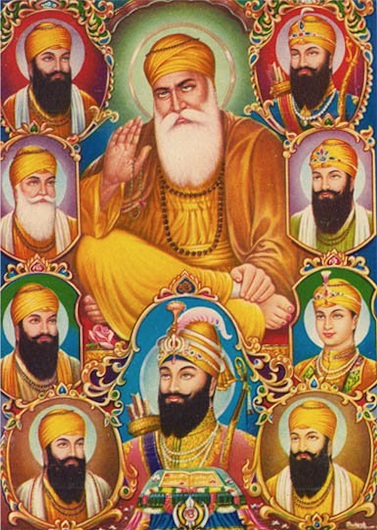
Guru Nanak,
"the Guru of the Hindus and the Pir of the Muslims"
declared the beginning of popular resistance against despotic cruelty when he wrote that
"the rulers are like tigers and the collectors of taxes are like dogs oppressing the public day and night."
Guru Nanak Sahib preached and wrote in the popular language of the people, touring the country extensively. He became the most popular reformer of his time.
Between the huge millstones of tyrannical rulers, bribe taking judges and greedy tax collectors on the one hand, and the corrupt clergy on the other, ordinary men and women of all religions, creeds and castes were being crushed. Kings had forgotten their duty to protect the people; and those in the garb of religion, instead of showing the true path to the people and the rulers, were themselves aiding the oppressive regimes. In fact, as Bhai Gurdas wrote,
the hedge meant to protect the field was itself destroying the field.
It is not surprising that popular Muslim and Hindu leaders and saints sided with the "Guru Ghar", the House of Guru Nanak. Teachings of Muslim and Hindu saints received the seal of the Guru's approval as the "Revealed Word" and were included in the Sikh Scriptures, Guru Granth Sahib.
Guru Nanak Sahib's universal movement of true religion and his call to the people to "fear none, frighten none" culminated in the Khalsa Panth by 1699, as a complete spiritual and temporal system. The Khalsa interpreted and defended the universal truths and human values taught in Guru Granth Sahib by sages of many religions - in a sense the parliament of faiths. The common values which the Khalsa promoted and defended were, respect for diversity and for all paths leading to the One Creator Being, and equality of all before the One Creator (e.g.
Aadm ki jaat sabhe ekay pehchaanbo
- Recognize all human race as one
(Guru Gobind Singh).
Flowing from these ideals was the concept of community service (seva) and sharing. "Guru ka Langar" or community kitchen where all are served without discrimination became a popular Khalsa institution - as powerful as the sword to resist and overcome the social and political injustice (therefore, "Degh Teg Fateh"). History records that the local poor Muslims mourned the arrest, torture and death of Bhai Taru Singh, a hard working saintly farmer, who ran a daily "Langar" for all.
Henceforth, the Khalsa, backed by popular support, spearheaded the struggle to establish a rule of the people, by the people, in which all were equal partners. Guru Nanak's mission was clarified as the establishment of,
"a regime in which no one inflicted pain on another as the Will of the Benevolent Lord."
(Guru Arjan Dev Ji).
Khalsa mission was supported by the people of Panjab
Shahid Ganj is a monument to the struggle of all ordinary people against a tyrannical regime and foreign invaders whose only aim was to loot and plunder. The word 'Turak' for 'Turk' appears to have been used in the sense of the "foreign invaders" from the north in Sikh writings rather than in relation to any religion. Some biased historians misleadingly interpret the popular uprising as some sort of religious conflict between the Hindus (led by the Khalsa) and the Muslims. Yet, the historical evidence, when taken together with the unique Khalsa ideology of Guru Nanak/Gobind Singh mission, is very different indeed.
All were suffering from administrative, religious, social and economic injustices. The rulers, the large landowners (jagirdars) and the clergy, were in collusion with each other. They were all exploiting religion and abusing own power and position for selfish ends. The cruelty inflicted by caste divisions and the superstitious practices used as tools for exploitation by the priestly class, was no less than that inflicted by the sword of the tyrannical rulers and merciless invaders. Guru Nanak's first rebellion was against the cruelty of the caste system when he refused to wear the sacred thread, which would have signified his high caste. He sided with the "lowliest of the low".
It needs to be mentioned that some of the greatest injustices were inflicted by the administrators at the time. For example, Chandu Diwan (Minister in Lahore court) may have played a role in the shahidi of Guru Arjan Dev Ji; the Cchota Ghalughara, the lesser in terms of loss of life but more damaging, of the two 18th Century pogroms against the Sikhs, was led by Lakhpat Rai, Diwan of Lahore. The list of treacherous 'informers' like Gangu (leading to the death of the young Sahibzadas (Princes) of Guru Gobind Singh, and Mahant Aakldaas of Jandialla, who was behind Bhai Taru Singh's shahidi, is a long one.
On the other hand the list of Islamic supporters of Guru Nanak's universal teachings and mission, from Guru Sahib's childhood to the demise of Guru Gobind Singh, runs parallel with Sikh history. Muslim warriors served with the Khalsa in many battles from Guru Gobind Singh to Maharaja Ranjit Singh - the latter's artillery was almost entirely in the hands of Muslim generals. Hazrat Mia Mir spoke out against the torture inflicted on the Fifth Guru, Arjan Dev Ji which caused his shahidi (30 May, 1606); Pir Budhu Shah came to Guru Gobind Singh's aid with his 700 disciples at a most critical time when he was under attack from the Hindu hill rajas at Bhangani (near Paonta Sahib) and his two sons were killed in the battle. Gani Khan and Nabi Khan brothers of Macchiwara gave shelter to Guru Gobind Singh when was being pursued by the Emperor's army. Nawab Maler Kotla spoke out against the killing of the two Sahibzadas of Guru Gobind Singh by the Nawab of Sahind. Baba Banda Singh Bahadur had 5,000 Muslim soldiers in his army.
Except for some historians with own biases, in no sense can the struggle for freedom of the people in north-western part of the Indian subcontinent be interpreted in terms of some sort of religious conflict. Both, the Muslims and the Hindus had accepted Guru Nanak as a reformer and a revolutionary, and their Pir and Guru respectively. Regardless of religion, all suffered from the excesses of a cruel regime. The sword arm which inflicted cruelty may have been Moghul, Durani, Afghani or Hindu (e.g. hill rajas and divans like Lakhpat Rai, supported by Brahmanical opposition to the liberating ideology of Guru Nanak). People were being crushed between inept Delhi rule and the invaders who descended periodically from the north-west. Guru Nanak Sahib predicted in 1505 AD ,
"They (the Mughals) shall come in (Vikrami) seventy-eight and depart in ninety seven, when another disciple of the brave Man (Khalsa) shall arise"
"Aavn aatthatre jaan staanvay, hor bhi utthsi mard ka chella".
Babar destroyed the Pathaans in 1578 Vikrami (1521 AD) and Nadir destroyed the Mughals in 1797 Vikrami (1739 AD).
To the people, Banda Singh Bahadur had shown that self government by the people was possible. According to one historian
"Banda was a great reformer, He broke down the barriers of caste, creed and religion. He appointed sweepers and cobblers as big officers before whom high caste Hindus, Brahmins and Kshatriyas stood with folded hands awaiting their orders. He believed in socialism. He distributed all his riches among his followers. He abolished the zamindari system and established peasant-proprietorship making actual tillers of the soil its masters."
Wrote Hari Ram Gupta
"Thus, the sturdy, plodding race of hereditary cultivators, whose diligence had built up the agricultural system of the Panjab, became as skilful in the use of the sword as they were in the use of the plough... Misery, misfortune, isolation, abandonment, poverty, privation, distress, are the battlefields which have their heroes, obscure heroes, sometimes greater than the renowned heroes."
And so,
"the hammering of the oppressive regime did not reduce them to pulp. It hardened them to tempered steel".
They resisted local oppression and they relieved the marauders from the north of their loot each time the latter returned with their spoils from Indian towns and countryside. They freed women and children from these raiders who intended to sell them as slaves.
Gurdwara Shahid Ganj Singh Singhania, Lahore, is a monument to the unique feats of courage and the great sacrifices made by ordinary people for human dignity and freedom.
(It is recommended that the 18th Century Sikh history is read by every young Sikh to experience the Khalsa ideology as it unfolded during that decisive period in Sikh history. This article is based mainly on well publicised Panjabi and English sources.
© Copyright Gurmukh Singh (U.K.)
E-mail: sewauk2005@yahoo.co.uk
Please acknowledge quotations from this article
Articles may be published subject to prior approval by the author