Sikh Missionary Society U.K. (Regd)
10, Featherstone Road.
Southall, Middx, U.K. UB2 5AA
Tel: +44 020 8574
1902
Fax: +44 020 8574
1912
Reg Charity No: 262404
|
Sikh Missionary Society U.K. (Regd)
10, Featherstone Road.
Southall, Middx, U.K. UB2 5AA
Tel: +44 020 8574
1902
Fax: +44 020 8574
1912
Reg Charity No: 262404
|
|
|
|---|---|---|---|
|
|
|||
THERE IS ONE GOD, ETERNAL TRUTH IS HIS NAME;The Sikhs believe in one God. The Sikh religion has rejected casteism. The Sikh religion is common, simple, easy, high and pure way of life. QUINTESSENCE OF SIKHISM: Sikhism exhorts the people to become serviceable transcendental meditation, honest, generous, charitable, self effacing, helpful to destitute, to face ups and downs of life cheerfully.
MAKER OF ALL THINGS,
FEARING NOTHING AND AT ENMITY WITH NOTHING,
TIMELESS IS HIS IMAGE,- NOT BEGOTTEN, BUT BEING OF HIS OWN BEING;
BY THE GRACE OF THE GURU, MADE KNOWN TO MEN.
Sikhism advises to give up superstitious, belief in omens and rituals. The Sikhs imbibe humbleness and sweetness. The Sikhs become veritable saints and saviours of weak, poor, needy and the destitute, oppressed and exploited brethren. The Sikhs have implacable hatred against injustice, deceit, hypocrisy, dishonesty and tyranny. The Sikh Gurus have bequeathed this inheritance to the Sikhs. The Sikhs are paragons of virtues and sacrifices. We are proud that we have expoused Sikhism.
Following the death of Guru Gobind Singh Ji, the Khalsa struggled militarily for survival. As an assembly (Sarbat Khalsa) it appointed Jathedars (leaders of Jathas) and passed Gumatas. Later the Dal Khalsa (Khalsa army) was divided into Misls. With Maharaja Ranjit Singh's reign came nearest realisation of Khalsa Rule. His court was the Darbar Khalsa Ji. The Khalsa remains the guardian of Sikh Principles.
"In the house of the Bedis was born Nanak, the king of kings,
Who brought joy to his followers and became their Refuge
Both here and in the Hereafter.Chaupai
He established Religion in this Dark age, And Showed the Path to all men of Faith. He who accepted his way,
Was afflicted not by sin.He who followed in his footsteps,
Him affected neither Sin nor Sorrow.
He was delivered of Pain and Hunger,
And was trapped not thereafter by Death.Then, Nanak assumed Angad's form,
And spread this Religion far and wide
Then, he was known as Amar Das,
As one light lights another.And when came time for the fulfilment of his blessings.
He was called Ram Das, the Guru.
It was in fulfilment of the age-old decree (God).
And, then, Amar Das left for the heavens.It was Nanak , the venerable, who was known as Angad.
Thereafter, it was Amar Das who assumed the form of Ram Das.
All this is known to men of faith; but the fools know not the mystery.They distinguished and separated one from the other.
And rare is the one who knows that they, indeed, were one.
They who realised this in their hearts, attained Realisation (of God).
But They who understood it not, were fulfilled not.Ram Das, then, merged in God,
Appointed Arjan as the Guru.
And when Arjan ascended to the heavens,
He established Har Govind in his place.When Har Govind proceeded to the -Abode of God,
It was Har Rai who was seated in his place.
After him came Hari Krishan, his son,
And then it was Tegh Bahadur who succeeded him.It was for the sake of the sacred thread and the ffontal-mark (of the Hindus),
That he performed a great act of chivalry.
To protect the holy, he offered all he had,
And, lo, he offered his head, but uttered not a sigh of regret.He suffered martyrdom for the sake of religion.
His head he gave, but not his honour.
God's men are, indeed, ashamed to act like showmen and perform tricksDohira
Having broken the (body's) earthen pitcher
On the head of the king of Delhi,
He departed to the world of God.
Nay, not one has performed the Deed
That Tegh Bahadur had.The whole world mourned his loss
And cried, 'Alas, alas', but the domain of gods
Resounded with the sounds of "Victory, Victory, Victory be to the man of God"."
Today, Sikhs across she World celebrate Vaisakhi. It is a joyous occasion when the community gets together.
Guru Nanak's knowledge of the Truth (God) was Prophetic. Kapoor Singh observes: 'A revealed religion is one which is imparted through a chosen individual as a consequence of his encounter with God.'
The Religious Truths Guru Nanak preached have been revealed to h'im through a direct and face to face encounter with God at some level of consciousness about which our psychological insight and verbal technology, that we have today acquired and fashioned to express our ideas, are still almost blind and incapable of comprehending.
Guru Nanak Dev Ji was born in 1469. By 1699, the tenth Guru Nanak, Guru Gobind Singh Ji, inaugurated his followers into a Nation of Sikhs called the Khalsa. It was Waheguru's own army (Khalsa Akaal Purkb Ki Fauj). It had been revealed to the world by God through Guru Gobind Singh ji (Pargateo Khalsa Parmatam ki Mauj). Sikh men and women were initiated into the Khalsa by sharing Khande-di-Pahul. The Amrit (the elixir of life) is a symbol of loyalty to the Guru and a hope for a higher spiritual existence. The ideal of the true Sikh became 'Sant-Sipahi' (Saint-Soldier) of the Khalsa who lives by the cognate virtues revealed by Guru Nanak Dev Ji and Guru Gobind Singh Ji.
'Let him, who calls himself a Sikh of the True Guru,Meditation on the Name of God (Naam Simran) was and is the most important thing for Sikhs living by a discipline prescribed clearly by the Guru.
Rise early and meditate on God; Let hint exert himself in the morning and bathe in the tank of Nectar.
Let him repeat God's Name, under the Guru's instruction; Thus shall his sins and errors-be erased.
Let him at sunrise sing the Guru's kymns; Sitting or standing, he should meditate on God's Name. The Disciple, who at every breath, meditates on God, will please the Guru's heart.
He alone takes the Guru's instruction, who is by the Lord's mercy so guided.
The slave Nanak seeks the dust of thefeet of him, Who himself repeats God's Name, and leads others to do so.'
Guru Granth Sahib, pg 305-306
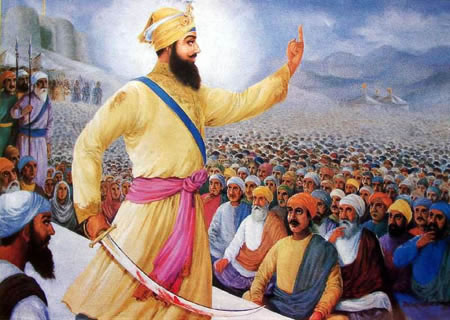 Guru
Gobind Singh initiated the Khalsa, by a Divine order, on Vaisakhi 1699.
The events of that day have been recorded by a Mughal news writer. Guru
Gobind Singh had come out in front of a congregation of thousands and,
with his Sword drawn, demanded to know if anyone was prepared to give his
head to him (i.e. accept death at his bidding). The congregation was startled.
Why was Guru Ji asking for heads? Were they prepared to die for him? Again,
Guru Ji repeated the question. No one came forward. On the third call a
Sikh stood up. He approached the Guru and offered his life to him. Guru
ji seized him by the arm and led him into a tent.
Guru
Gobind Singh initiated the Khalsa, by a Divine order, on Vaisakhi 1699.
The events of that day have been recorded by a Mughal news writer. Guru
Gobind Singh had come out in front of a congregation of thousands and,
with his Sword drawn, demanded to know if anyone was prepared to give his
head to him (i.e. accept death at his bidding). The congregation was startled.
Why was Guru Ji asking for heads? Were they prepared to die for him? Again,
Guru Ji repeated the question. No one came forward. On the third call a
Sikh stood up. He approached the Guru and offered his life to him. Guru
ji seized him by the arm and led him into a tent.
Slowly, one by one, five Sikhs accepted the Guru's request and were
led away into the tent that had been erected. Each time the Guru emerged
from the tent the congregation were sure Guru Ji had killed the Sikh inside.
Guru Gobind Singh finally emerged from the tent with the same five Sikhs
all dressed identically. The Guru then initiated them into the Khalsa through
the Khande-di-pahul ceremony. These five Sikhs were named the Panj Pyaras
(the Five Beloved Ones). The names of these Panj Pyaras are,
They came forward in this order.
| 1. Bhai Daya Ram | He was a Khatri from Lahore and was named Bhai DAYA Singh. |
| 2. Bhai Dharam Dass | He was a Jat (Farmer) from Delhi and was named Bhai DHARAM Singh. |
| 3. Bhai Mohkam Chand | He was a washer man from Dwarka and was named Bhai MOHKAM Singh. |
| 4. Bhai Sahib Chand | He was a barber from Bidar and was named Bhai SAHIB Singh. |
| 5. Bhai Himmat Rai | He was a water-carrier from Jagan-Nath and was named Bhai HIMMAT Singh. |
All the five hailing from different places, belonging to different castes and having different social status were brought on an equal footing and called "BHAI" - BROTHER.The news writer at the time sent the Emperor of India a copy of the Guru's address to his Sikhs during that Vaisakhi. Guru Ji said,'Let all embrace one creed and obliterate differences of religion. Let the four Hindu castes who have different rules for their guidance abandon them all, adopt the one form of adoration, and become brothers. Let no one deem himself superior to another. Let none pay heed to the Ganges, and other places of pilgrimage, or adore incamations such as Ram, Krishna, Brahma, and Durga, but believe in Guru Nanak and the other Sikh Gurus. Let men of the four castes receive my baptism, eat out of one dish, and feel no disgust or contempt for one another.'From 'The Sikh Religion.' by M.A. Macauliffe Vol 5, pp. 92, first published 1909 and reprinted 1995.This clearly indicates the spiritual equality of the Khalsa. Guru Ji made the Sovereign authority of the Khalsa very clear.The Ballad, associated with Guru HarGobind, maintains that Sikhs have been given sovereignty over both their Spiritual and Political worlds by Akaal Purkh (miri piri),
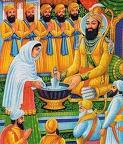
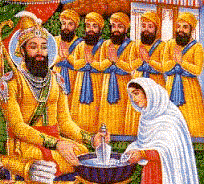 The
Khande-di-Pahul ceremony has been recorded in the SIKH REHAT MARYADA. Briefly,
water and sugar crystals are poured into a iron bowl (Bata). Tradition
records that the original sugar crystals had been added by Mata Sahib Kaur,
the Mother of the Khalsa. This is then stirred with a Khanda by the Panj
Pyaras whilst reciting Gurbani. The five Banis recited are JAPJI, JAAP,
SUDHA SAVAIYA, CHAUPAI AND ANAND. Through this highly spiritual process
is Amrit prepared.
The
Khande-di-Pahul ceremony has been recorded in the SIKH REHAT MARYADA. Briefly,
water and sugar crystals are poured into a iron bowl (Bata). Tradition
records that the original sugar crystals had been added by Mata Sahib Kaur,
the Mother of the Khalsa. This is then stirred with a Khanda by the Panj
Pyaras whilst reciting Gurbani. The five Banis recited are JAPJI, JAAP,
SUDHA SAVAIYA, CHAUPAI AND ANAND. Through this highly spiritual process
is Amrit prepared.
The Amrit is then given to each of the initiates. Firstly, five handfuls are given to the Sikh to drink. After this, Amrit is sprinkled into the Sikh's eyes five times. Finally, five handfuls of Amrit are poured into the Sikhs hair. Each time this happens the Sikh repeats 'Waheguru Ji Ka Khalsa, Waheguru Ji Ki Fateh'.
The Amrit which remains, is then sipped by the initiates. The Amrit is drunk by every Sikh, and then taken back in reverse order to ensure that the Sikh who first drunk the Amrit is eventually last one to drink it. This is done to eliminate any ideas of superiority among the initiates,
The Sikhs are then given the Mul Mantr and Gur Mantr from the Panj Pyaras. They are enjoined to remember and contemplate these at all times.
| Ek Oankar | There is only One God, |
| Satnam, | His Name is eternal Truth, |
| Karta Purakh, | The Creator, |
| Nirbhau, | Without fear, |
| Nirvair, | Without anger, |
| Akal Murat, | The timeless being, |
| Ajuni, | Unborn, |
| Saibhang, | Self existent, |
| GurPrasad. | Realised by the Guru's Grace |
The Mul Mantr gives the unique virtues of God as revealed to Guru Nanak. Sikhs are encouraged to contemplate these virtues at all times.
The Gur Mantr is,
WAHEGURU; The Wonderful Master.
Again, this is a unique description of God. God, through his grace, takes us from the darkness of ego to the realisation of his light (Joti) within.
The Khalsa worships only One God. Meditation, as taught by the Guru, is the means by which we can receive the grace of God and become totally absorbed in the Almighty's presence.
Guru Gobind Singh laid down four prohibitions, which all Sikhs are to
avoid. Breaking these prohibitions entails seeking punishment and resubmission
into the Khalsa from the Panj Pyaras.
All Sikh men keep the surname SINGH (meaning Lion), and all Sikh women keep the surname KAUR (meaning Princess). Thus, those who join the Khalsa are able to keep their identity. They are a part of a family. This is important for Sikh women as they no longer have to change their names when they marry. This is the uniqueness of the Khalsa.
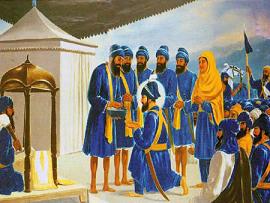 By
asking for heads during Vaisakhi 1699 the Guru had tested the congregation
to see who gave full allegiance to him and was prepared to die for the
Guru. After initiating the Panj Pyaras, Guru Gobind Singh knelt before
them and requested to be initiated into the Khalsa too. Just as Guru Nanak
had bowed before Guru Angad when he made him Guru, so Guru Gobind Singh
had knelt before the Panj Pyaras, for they had passed the ultimate test.
They were prepared to sacrifice their lives for the Guru and so he was
prepared to give them everything. Sikhs now join the Khalsa and receive
Amrit from the Panj Pyaras, the embodiment of Guru Gobind Singh Ji.
By
asking for heads during Vaisakhi 1699 the Guru had tested the congregation
to see who gave full allegiance to him and was prepared to die for the
Guru. After initiating the Panj Pyaras, Guru Gobind Singh knelt before
them and requested to be initiated into the Khalsa too. Just as Guru Nanak
had bowed before Guru Angad when he made him Guru, so Guru Gobind Singh
had knelt before the Panj Pyaras, for they had passed the ultimate test.
They were prepared to sacrifice their lives for the Guru and so he was
prepared to give them everything. Sikhs now join the Khalsa and receive
Amrit from the Panj Pyaras, the embodiment of Guru Gobind Singh Ji.
The great respect Guru Gobind Singh had for the Khalsa can be seen from his Bani.
'He (The Khalsa) meditates on the Ever-radiant light, day and night, and rejects all else but the one lord from his mind.Some consider the Khalsa Panth to be merely a military order. This is a fallacy. It's importance lies in its religious and political role. The ideals of the Khalsa had always been present within the sangat. Guru Gobind Singh Ji finally institutionalised the Sangat and gave it the responsibility and status it had always held within Sikhism.
He whose mind dwells, night and day, on the ever effulgent Light and who gives not a moment's thought to ought but the One,
Who wears Perfect Love, with faith, and believes not even mistakenly in fasting, tombs, crematoriums, and hermitages,
Nor in pilgrimages, nor customary charities, nor a set code of self-discipline,
And believes in the One alone and not another,
And When God's Light illumines perfectly in his heart, then is he known a Khalsa, purest of the pure!'
Sikhs are spread all over the world and yet little is known about them. Some look upon a Sikh as an oddity, an archaic ethnic character from an ancient Eastern world. Sikhs are the practitioners of a modern religion, Sikhism, which is a unique faith. Also, the Sikhs are the heirs of mighty nation of unsurpassed military glory and political power which, when challenged, shook the British Empire. They would have chased the British out of India had it not been for the treachery planted by the British amongst the misguided Generals of the Sikh army. Cheated of their political rights during the partition of India the Sikhs are today branded, by their fellow citizens, as traitors and separatists for demanding a measure of autonomy for Punjab, their ancestral homeland. Sikhs are not separatist but are "the separated." "They are separated from the Indian mainstream by unequal laws, religious and social bigotry and the destruction and desecration of their places of worship." In spite of all this, far from feeling insecure, the Sikhs remain as confident as ever and strive to live in Chardi Kala (high spirits). They continue to sing Raj Karega Khalsa for the fulfilment of their aspirations.
Sikhism is concerned with the creation of a just social order, social equality and peaceful coexistence as proclaimed by Guru Arjan in the following words:
'The gracious Lord has now promulgated His ordinance:
None shall domineer over others or cause pain to them.
All shall abide in peace
and the governance shall be gentle and compassionate'
Guru Granth Sahib, pg. 74
 The
Sikhs had given a good thrashing to the returning armies of Ahmed Shah
Abdali after the Battle of Panipat. Angered by this, Abdali decided to
teach the Sikhs a lesson in his next invasion. Although the Sikhs had prepared
for safety in anticipation of the attack, yet the suddenness with which
it came took them by surprise. Consequently thousands of Sikhs laid down
their lives fighting in the plains of Kup. Under the command of Jassa Singh
Ahluwalia, the various Sikh Misls (confederacies) came together and fought
unitedly to save the Panth. This Massacre, known as Vada Ghallughara (Great
Holocaust), claimed the lives of over fifty thousand Sikhs. Nonetheless,
the same year, Sikhs took over Sarhind and celebrated VAISAKHI in the HARMANDIR
SAHIB.
The
Sikhs had given a good thrashing to the returning armies of Ahmed Shah
Abdali after the Battle of Panipat. Angered by this, Abdali decided to
teach the Sikhs a lesson in his next invasion. Although the Sikhs had prepared
for safety in anticipation of the attack, yet the suddenness with which
it came took them by surprise. Consequently thousands of Sikhs laid down
their lives fighting in the plains of Kup. Under the command of Jassa Singh
Ahluwalia, the various Sikh Misls (confederacies) came together and fought
unitedly to save the Panth. This Massacre, known as Vada Ghallughara (Great
Holocaust), claimed the lives of over fifty thousand Sikhs. Nonetheless,
the same year, Sikhs took over Sarhind and celebrated VAISAKHI in the HARMANDIR
SAHIB.
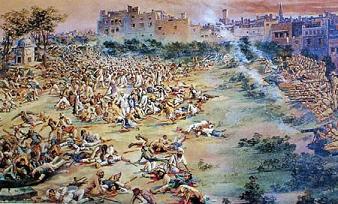 Thousands
of Punjabis, assembled for VAISAKHI at the Jallianwala Bagh, were caught
unaware, when General Dyer ordered gunfire at them without any warning.
Nearly 1500 people were killed; out of which 347 were Singhs. The killings
at the Jallianwala Bagh evoked strong reactions of anger and grief in the
whole country.
Thousands
of Punjabis, assembled for VAISAKHI at the Jallianwala Bagh, were caught
unaware, when General Dyer ordered gunfire at them without any warning.
Nearly 1500 people were killed; out of which 347 were Singhs. The killings
at the Jallianwala Bagh evoked strong reactions of anger and grief in the
whole country.
Guru Nanak taught that, whether people of that time were Hindu or Muslim,
they should live honest lives and be true to the one God. He also taught
that a person could serve God within ordinary, daily life.
So, for example - contrary to what some people believed a person did
not have to leave home and family to become fully devoted to God.
Before Guru Nanak died, he appointed one of his closest disciples Angad,
to be the next Guru of the Sikh community. Angad appointed a successor.
In all there were ten human Sikh Gurus, each appointed by their predecessor-
1) Guru Nanak Dev 1469-1539
2) Guru Angad Dev 1504-1552 (became Guru 1539)
3) Guru Amar Das 1479-1574 (became Guru 1552)
4) Guru Ram Des 1534-1581 (beacme Guru 1574)
5) Guru Arjan Dev 1563-1606 (became Guru 1581)
6) Guru Hargobind Rai 1595-1644 (became Guru 1606)
7) Guru Har Rai 1630-1661 (became Guru 1644)
8) Guru Har Krishan 1656-1664 (became Guru 1661)
9) Guru Tegh Bahadur 1621-1675 (became Guru 1664)
10) Guru Gobind Singh 1666-1708 (became Guru 1675)
Each of the Gurus is associated with particular periods or events in the evolution of the Sikh community. For example, it was the fifth Guru, Guru Arjan, who compiled an early collection of writings. The building which is now commonly known to non-Sikh as the Golden Temple in Amtritsar, but referred to as Harmandir Sahib by Sikhs, also owes its origin to this Guru
The Tenth Guru, Gobind Singh, was notable for a number of reasons. Firstly he created the Khalsa brotherhood of baptised Sikhs, in 1699, He called a great meeting of the Sikh community in the city of Anandpur. He asked for five Sikhs who would give their lives for their Guru. The five men who offered their lives were baptised by Gobind Singh and wore five distinguishing marks of the baptised Sikh- the five Ks (so called because they each begin with the same sound "K" in the Panjabi language) The Guru was baptised by the five who he had baptised. Many more were baptised that day and all took responsibility for wearing the five "K"s. Guru Gobind Singh also said that in order to show their equality and unity, all Sikh men would be called "Singh" (lion) and all women "Kaur" (princess).
He also said that after his death, the Sikh Nation should no longer obtain their teachings from a human Guru. Instead authority would reside in the Sikh Nation (the Panth) and in THE GURU GRANTH SAHIB which includes words which had been revealed to the Gurus. Thus the Sikhs refer to their sacred book as a Guru -THE GURU GRANTH SAHIB- because they regard it as a living Guru, and continue to give it the honour that they would accord to the human Gurus in their day. What has impressed the world about Sikhs is -their superb martial quality. They make excellent soldiers and officers in all branches of the defence forces of India and, because of their bravery, aptitude for discipline and tradition for fearlessness on the battle field, are recruited in numbers in India's armed forces in greater numbers than the proportion of the population of India would warrant. Their ardent patriotism is another great quality which has won them universal admiration and respect.
Sikhs can easily be recognised by their distinct physical appearance. They wear their hair and beards un-shorn, and cover their heads with a turban. No other headgear is permissible for them. They are remembered and addressed with the honourable title of "sardar" or "sirdar" which means a man of high standing. All male Sikhs names end in "Singh" which means lion and all female name end with "Kaur," which means princess . This was ordained by their last Guru the apostle, Guru Gobind Singh. Sikhs have come from various Hindu tribes and castes. There have been many conventions also. Considerable number of American born people have adopted the faith, and seem to respect its observances with commendable loyalty. Sikhism does not sanction belief in the caste system. and all human beings are held to be equally deserving of divine grace, and equally entitled to receive the teachings of religion.
|
|